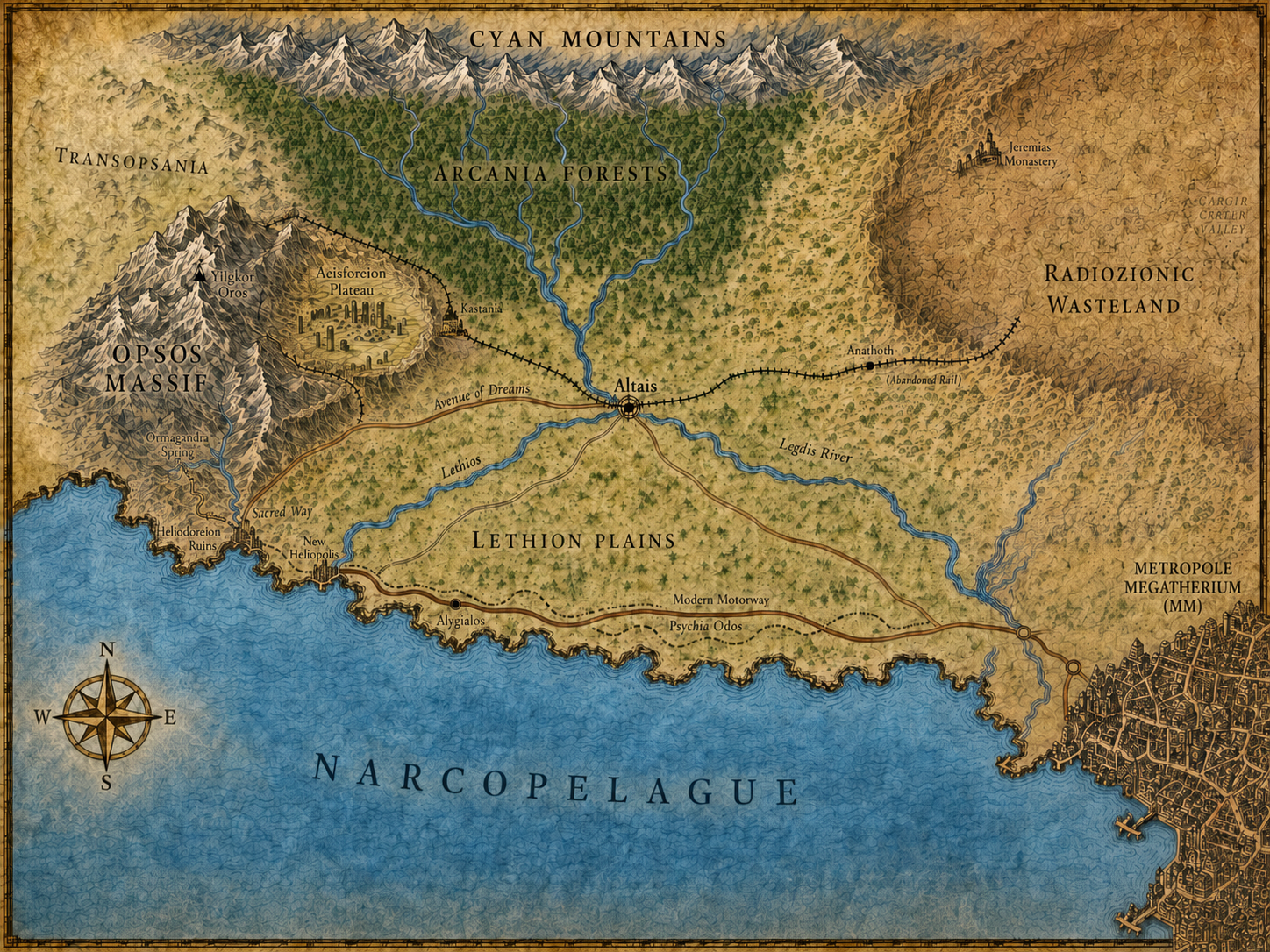
REMSEARCH has published a new stable cartographic model of Psychia. The update reflects the configuration that currently shows the highest degree of geographical continuity across repeated observations. Archive reference: REMSEARCH-CART/02491
This page serves as the official cartographic register for the current model. Future revisions, major deviations and earlier stabilized maps will be documented here as new data becomes available.
Older cartography
Early attempts to map Psychia were based on the assumption that its geography could be measured as a stable physical system. Coastlines, roads and borders were recorded accordingly, yet subsequent observations often failed to confirm them.
The discrepancies became increasingly difficult to dismiss. Landmasses shifted, distances changed, and regions appeared in different locations or, in some records, more than one place at once. Errors of observation, corrupted records and changes within the dream state may account for some cases. They do not explain them all.
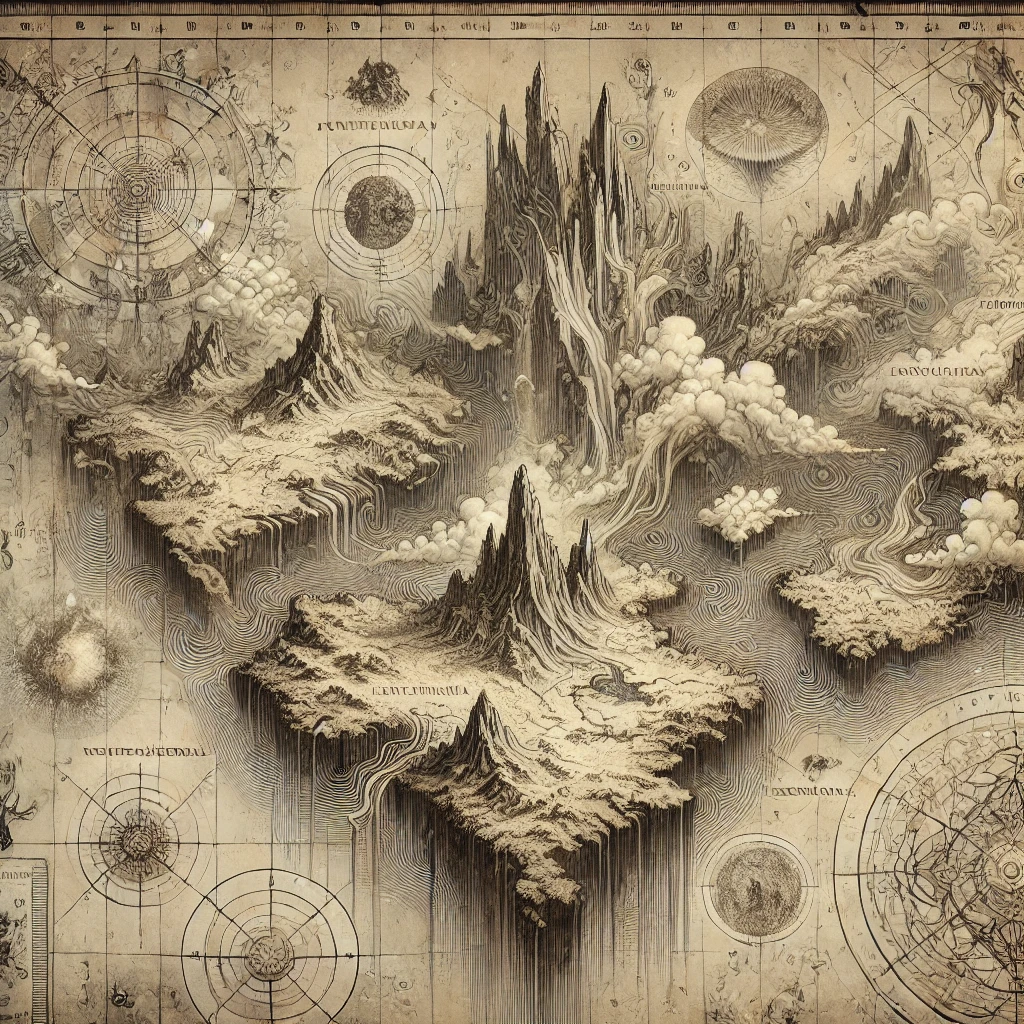
One of the many maps of Psychia preserved in the REMSEARCH Institute archives. Landmasses and structures appear to shift with each observation, and no map has ever been confirmed as definitive. Archive reference: REMSEARCH-CART/01427

Explanations
By the later stages of Psychia’s cartographic research, a more unsettling possibility had emerged: observation itself might influence what was being observed.
This possibility would come to reshape the way Psychia was understood. The world appeared to resist fixed boundaries, and the distinction between observer and observed seemed less clear than conventional cartography assumed. The question was no longer simply how to map Psychia, but whether the dream belongs to the dreamer—or the dreamer to the dream.
This does not make the older maps useless. Even when no longer geographically accurate, they remain records of particular observations: evidence of how Psychia appeared at a given moment, and perhaps of what a particular observer was capable of perceiving.
Alternative Cartography
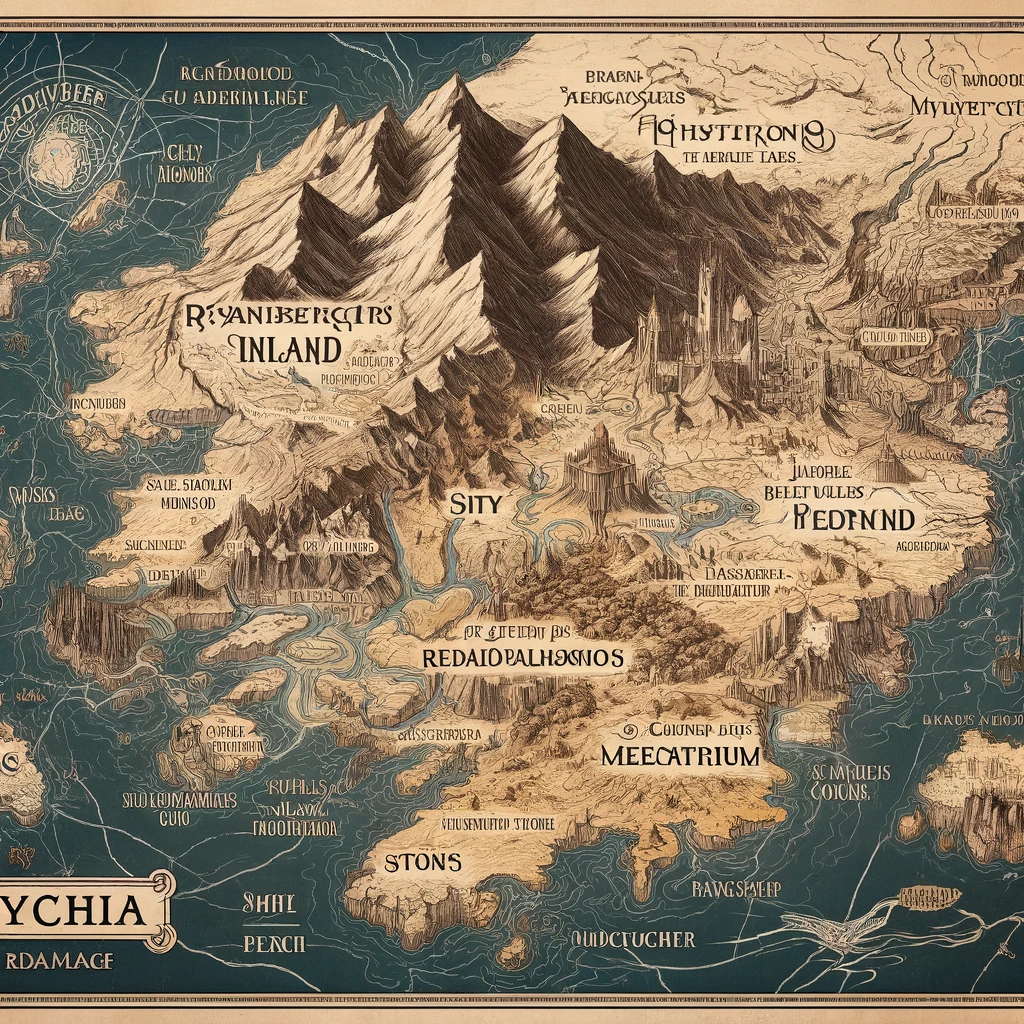
The artist and oneironaut Lyra Beaumont* approached Psychia through painting rather than conventional mapping. In her own words, she was no longer trying to determine where Psychia was, but what remained when direction itself ceased to be useful:
“There are maps you study, and there are maps you enter. I do not say that entirely as a metaphor. After years of looking at other people’s attempts, I turned to my own work—not to make a map. I painted what remained when direction stopped helping.
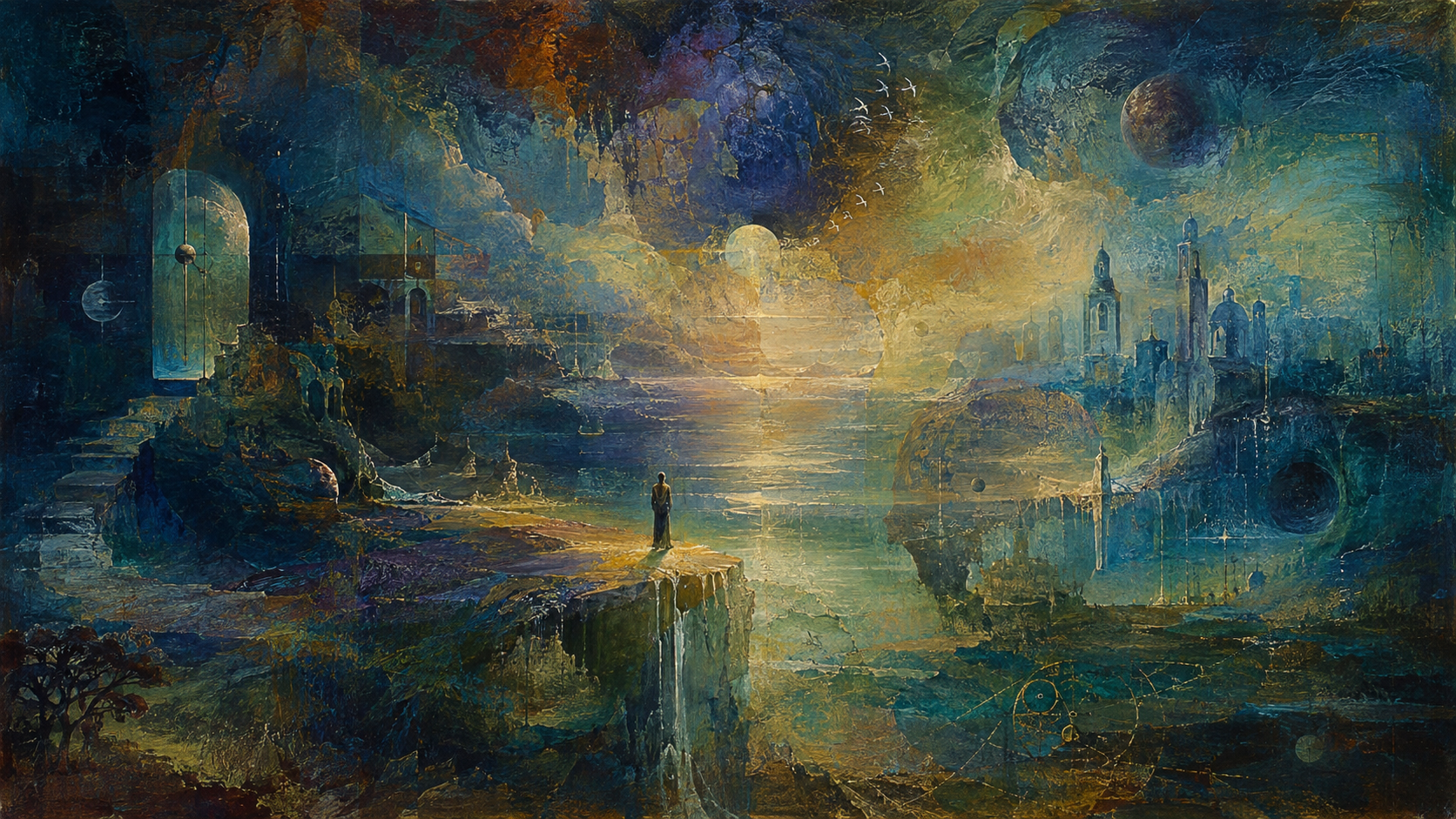
Psychia, Oil on canvas, 1972, by Lyra Beaumont
“What you see here is Psychia in a lucid dream from 1972. I cannot tell you where it is. I am no longer certain that is the right question. While I was painting it, there were moments when the canvas seemed less like a surface and more like a boundary. And I no longer believe every boundary is meant to be observed from the outside.”
* Lyra Beaumont, a Los Angeles Oneironaut active in the 1970s, explored dreams, cosmic symbolism, time and the boundary between dream and waking reality through her art.